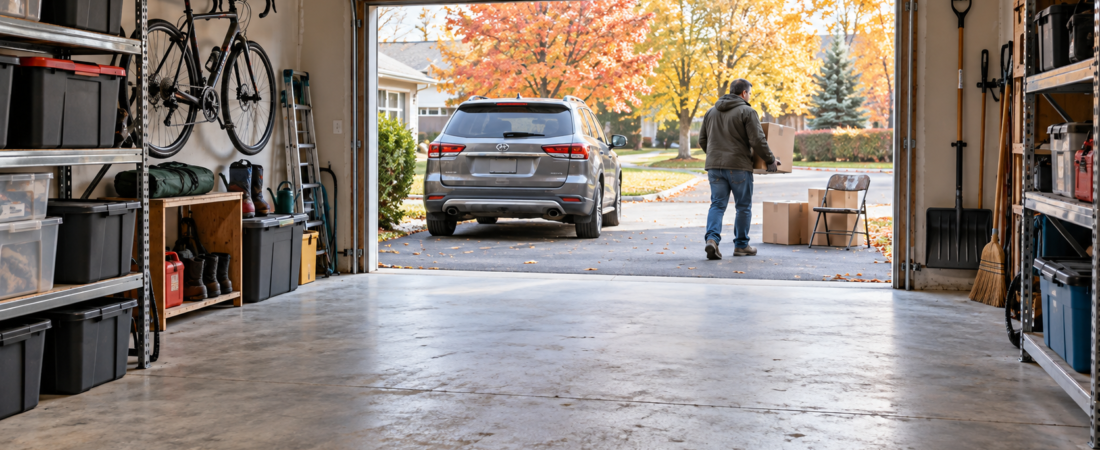
A useful fall garage cleanout checklist starts with the space you need to regain. Decide where your vehicle will park, how its doors will open and where winter equipment will stay. Then sort belongings around that plan, arrange suitable removal for unwanted items and confirm the finished space works before filling it with new storage.
For London, Ontario homeowners, October is a practical time to tackle the boxes, broken furniture and unused equipment that have gradually displaced the car. You do not have to empty the whole garage onto the driveway or lift heavy objects yourself. A focused cleanout can start with one parking bay and the route between the vehicle and your house.
If bulky items are preventing that change, the existing garage cleanout quote page explains how to describe the removal job. London Junk Removal Quotes accepts enquiries that may be connected with independent providers; the responding provider confirms materials, labour, pricing and availability.
Start with a parking and access plan
Before buying shelves or deciding how many boxes to keep, measure the usable space. Include the vehicle’s footprint, room to open doors and the path you use to enter the home. Check whether anything projects into that area, including a workbench, freezer, bicycle handlebars or a stack of containers.
Avoid estimating the fit by looking at the garage from the driveway. An apparently clear floor can still leave too little room to get out of the car. A wide cabinet near the driver’s door may be a bigger problem than several boxes at the back.
Write down three outcomes for the project. For example: park one vehicle inside, reach the shovel without moving boxes and keep a clear walking route. These goals make decisions easier when an item is usable but has no practical place in the garage.
| Garage area | Question to answer | Cleanout priority |
| Parking bay | Can the vehicle fit with usable door clearance? | Remove items occupying the required floor area |
| Route to the house | Can people walk through without stepping over storage? | Relocate or remove obstructions |
| Winter equipment | Can you reach the shovel and seasonal supplies directly? | Give retained equipment an accessible home |
| Work area | Which tools and materials are actually used? | Separate useful equipment from broken duplicates |
| Long-term storage | Does each box have an identified owner and purpose? | Review unknown contents before deciding |
| Garage-door area | Is storage interfering with normal operation? | Keep belongings clear of moving components |
Leave garage-door adjustments, wiring changes and new overhead storage installations to appropriate help. Removing clutter does not establish that an old shelf or ceiling attachment can safely carry more weight.
Sort in small sections and keep decisions visible
Work through one shelf, corner or group of boxes at a time. Emptying everything at once can turn a manageable decision into a driveway full of belongings that must be returned before rain or darkness.
Use separate groups for:
- Items staying in the garage.
- Belongings that have a better place elsewhere in the home.
- Usable items intended for sale, donation or an agreed handoff.
- Ordinary unwanted items being considered for removal.
- Products or equipment needing a separate disposal decision.
Give uncertain belongings a short review period with a named decision-maker. A box marked “ask someone” can sit for another year unless a person and next step are attached to it. If it belongs to another household member, ask before treating it as unwanted.
Keep retained items clearly separate from the removal group. A simple written inventory helps when a provider sees shelves containing both wanted and unwanted belongings. Do not assume a crew will infer your decisions from where something sits.
The site’s room-by-room junk removal preparation guide covers general appointment preparation. For this seasonal project, keep returning to the parking and winter-access goals instead of trying to redesign every room.
Identify the items that are blocking the result
The biggest visual pile is not always the most useful place to start. A few awkward objects may account for most of the lost parking space: a spare sofa, a broken cabinet, an unused exercise machine or an old appliance kept “just in case.”
List those objects individually. Note their approximate dimensions, condition and position. If a freezer is behind shelving or a cabinet is attached to the wall, describe that obstacle rather than counting it as a simple loose item.
Also inspect containers before declaring their contents removable. A box holding lightweight decorations is different from one containing tools, tiles or automotive products. Unknown contents make both sorting and quote preparation less reliable.
For appliance-heavy projects, review the appliance removal quote information. A provider may accept an appliance as part of a garage cleanout, but the connection status and item type still matter.
Give household products a separate route
Garages often contain paint, fuel, oils, chemicals, batteries and pressurized cylinders. Keep these identifiable and separate from ordinary boxes or furniture. Do not pour products together, empty them into drains or hide them in a bag of household junk.
Ask for item-specific acceptance and handling instructions before arranging transport. Mention leaks, damaged containers and unknown products without opening or transferring material to investigate it. A mower or other fuel-powered machine also needs a separate conversation about its remaining fuel and preparation.
Use the City of London’s household hazardous-product guidance to check available local options. A removal quote for ordinary garage contents does not establish that these products are included.
This separation is useful even when most of the cleanout is straightforward. Finding an unreported container at the end of loading can change what is removable and leave you with a different job than the one quoted.
Choose a removal route for each group
You can use more than one route without turning the cleanout into several competing projects. The aim is to make sure each group has a realistic destination and someone responsible for completing the next step.
| Route | When it may fit | Confirm before relying on it |
| Keep and reorganize | The item supports a real household need | It has a usable location outside the parking and walking space |
| Sell or give away | The item is usable and someone wants it | Collection timing, access and who will move it |
| Donation | A recipient accepts the item in its current condition | Acceptance, appointments and transport requirements |
| Municipal collection or drop-off | The material qualifies for a current local program | Eligibility, preparation, destination and schedule |
| Independent removal provider | Bulky items, indoor loading or a mixed cleanout need help | Accepted materials, loading scope, exclusions and total quote |
Do not describe a donation intention as a confirmed donation. A usable cabinet can still be refused because of condition, dimensions or a recipient’s current capacity. Have a backup plan if the parking bay depends on its departure.
For municipal options, consult the City’s garbage and recycling information. Check the particular material rather than assuming that everything stored in a residential garage qualifies for the same collection stream.
Prepare a quote around the actual garage job
A clear request should let a provider understand what is leaving and how to reach it. Include the main bulky items, approximate number of boxes or bags, unusual materials and whether sorting is complete.
Describe driveway access, garage entrance width, any steps and the likely carrying distance. If wanted belongings obstruct an unwanted item, explain that situation. Avoid describing a deep, tightly packed garage only as “half full”; the visible floor area does not show everything behind or above it.
Photograph the overall removal group and the access route from safe positions. Do not move heavy objects just to make the image cleaner. The existing guide to junk-removal quote photos explains how to show depth and individual bulky items. Ask the responding provider how to share photos; the current general contact form does not show a photo-upload field.
Before booking, confirm:
1. Which listed items are accepted and which remain excluded.
2. Whether removal from inside the garage and loading are included.
3. Whether disassembly or detachment is required, and who handles it.
4. How any additional material would affect the agreed scope and price.
5. Whether basic sweeping is included or the job ends with item removal.
6. The appointment arrangements, payment terms and any cancellation conditions.
For broader pricing questions, use the existing junk removal cost guide. There is no single price implied by this checklist.
A focused cleanout example
Imagine a garage with working wall storage, several unknown boxes, one unwanted cabinet and a broken chair occupying the driver’s side of the parking bay. The goal is to park a vehicle and reach the winter equipment.
First, review the boxes and return retained items to the wall storage. Next, identify the cabinet and chair as the removal group and confirm whether the cabinet is free-standing. Give any discovered household products their own handling decision. Finally, obtain a quote for the actual unwanted items and access conditions.
This is a planning example, not a completed customer project or a promise about cost. Its value is the sequence: solve the obstruction, preserve useful storage and avoid paying to remove belongings that have not been reviewed.
Check the space after removal
Once unwanted items are gone, check the result against the original goals. Open the vehicle doors, walk the usual route and reach the winter equipment. Keep any cleaning or maintenance you still need separate from the removal scope.
Give remaining belongings definite locations. Review the parking area periodically so packaging, donations awaiting pickup and seasonal purchases do not gradually return to the same floor space.
Common setbacks include buying storage before deciding what stays, moving garage clutter into the basement, assuming all chemicals are accepted and leaving a donation pile without a collection arrangement. A successful fall cleanout depends on completed decisions, not just a tidier pile.
Frequently asked questions
When should I start a fall garage cleanout?
Start while you can still sort comfortably and arrange removal before you need the parking space. October is a useful planning window, but provider availability and your household schedule determine the actual date.
Do I have to empty the entire garage?
No. You can focus on the parking bay, walking route and items blocking winter equipment. Make the removal group and retained belongings clear before requesting a quote.
Should I buy shelving before sorting?
Decide what stays first. Otherwise, new shelves may store unwanted belongings or reduce the clearance you were trying to recover.
Can I leave wanted items beside the junk?
Clearly separate or mark them and provide a written removal list. Review the scope with the responding provider before loading starts.
Do I need to move heavy garage items outside?
Ask whether indoor removal is included. Do not attempt unsafe lifting to prepare a request; explain where the items are located and what blocks access.
Can an old fridge be included in a garage cleanout?
Possibly, if the provider accepts it. Describe the appliance, its condition and connection status, and confirm the handling requirements before booking.
What should I do with paint, fuel or propane cylinders?
Keep them separate and obtain specific acceptance and disposal instructions. Do not assume an ordinary garage cleanout includes them.
Will a removal provider donate my usable items?
Only rely on donation when the provider confirms that arrangement and the recipient accepts the items. Ask what happens if donation is declined.
Is garage sweeping included?
It depends on the agreed quote. Confirm whether the service includes basic sweeping or only the removal and loading of identified items.
Does London Junk Removal Quotes supply the crew?
The website is an independent quote-request service. Any responding provider is responsible for its own pricing, schedule and work; submitting an enquiry does not book a crew.
Request help with the items preventing winter parking
Identify what needs to leave, describe the garage access and include your preferred timing. Request a free, no-obligation junk removal quote to begin the enquiry process, then confirm the final scope and arrangements directly with the responding provider.