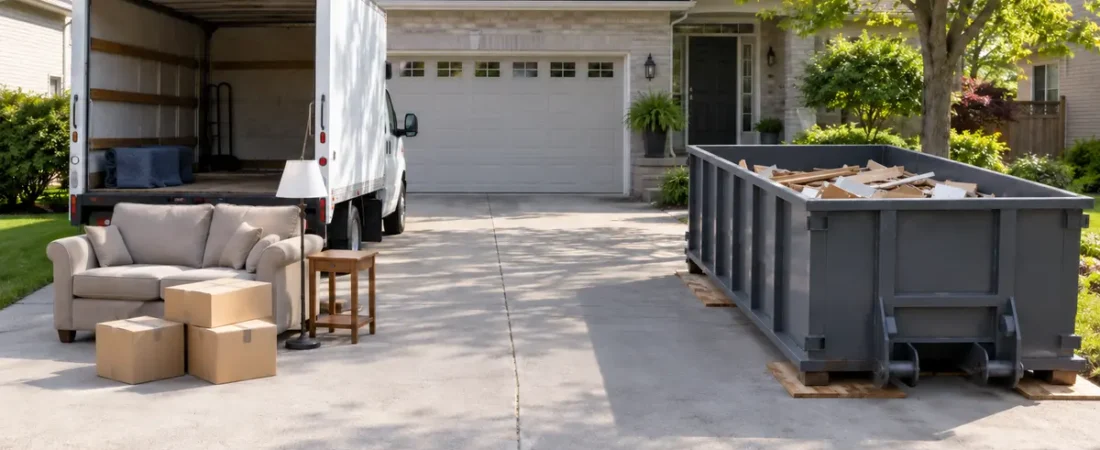
Compare labour, timing, space, materials and total project responsibility before choosing
When comparing junk removal vs dumpster rental in London, Ontario, the best option depends less on the name of the service and more on how your project will actually happen. Full-service junk removal usually fits a one-time cleanout when unwanted items are already accumulated, some belongings are heavy or indoors, and you want the responding provider to supply the loading labour included in the agreed scope. Dumpster rental—also called bin rental or roll-off bin rental—often fits a project that creates debris over several days and already has people available to load it.
Neither option is automatically cheaper, faster, or more suitable for every job. The total decision depends on the amount and type of material, who can lift it safely, how long the cleanup will take, where a container could be placed, what each provider accepts, and what the quoted price includes.
Use the comparison below to narrow the choice. If full-service removal appears to fit, you can request a no-obligation junk-removal quote in London, Ontario. London Junk Removal Quotes does not rent dumpsters and does not perform the removal; the responding provider confirms the scope, loading, accepted items, price, availability, and service terms.
Last reviewed: September 7, 2026. Provider terms, municipal requirements, facility rules, fees, and service availability can change. Confirm current details before booking either option.
Quick comparison: junk removal or dumpster rental?
| Decision factor | Full-service junk removal | Dumpster or bin rental |
|---|---|---|
| Who loads? | The provider generally supplies loading labour for the items included in the confirmed scope | You, your household, employees, or separately hired labour normally load the container |
| Typical project pattern | One scheduled removal visit after items have accumulated | A container remains for an agreed period while debris is generated and loaded |
| Best-known strength | Convenience when items are heavy, indoors, scattered among rooms, or tied to a deadline | Flexibility when a project produces material gradually and loading labour is already available |
| Space required | Vehicle access during the appointment | Suitable container placement for the delivery, rental, and pickup period |
| Access issue | Stairs, elevators, narrow doors, carrying distance, and parking may affect the quote | Delivery width, overhead clearance, surface condition, container doors, and pickup access matter |
| Cost structure | Often based on volume, weight, labour, access, disposal, special handling, location, and timing | Often based on container size, rental period, delivery and pickup terms, included weight, material type, and possible overages |
| Material responsibility | Provider confirms what it will load and how it must be prepared | Renter must follow the bin provider’s material, fill-line, weight, and sorting rules |
| Property responsibility | Temporary access during the scheduled visit | Container occupies part of a driveway, lot, loading area, or approved right-of-way for longer |
| Good examples | Furniture pickup, basement or garage cleanout, move-out, rental turnover, estate contents, office furniture | Ongoing renovation, roofing or construction debris, staged landscaping work, multi-day DIY cleanup |
| Main question to ask | “Does the quote include loading from the item’s current location?” | “What is included, where can the bin sit, and what are the weight and material limits?” |
This table describes common service models, not universal promises. Some junk-removal quotes may be curbside-only. Some bin providers offer different container styles, rental periods, material categories, or loading assistance. Confirm the actual written terms.
How full-service junk removal generally works
With full-service junk removal, a provider normally reviews the items, access, and location; supplies a vehicle and labour for the agreed scope; loads the accepted material; and transports it according to its own arrangements and applicable requirements.
The key value is not simply the truck. It is the combination of loading, carrying, vehicle space, and hauling in one scheduled service. This can matter when a couch is in a basement, a dresser is upstairs, boxes are spread across several rooms, or a rental unit must be cleared before cleaning and repairs begin.
A typical quote request should explain:
- What items need to leave
- The approximate number of furniture pieces, appliances, boxes, bags, or piles
- Whether the items are in a basement, upper floor, backyard, garage, apartment, office, or storage room
- Stairs, elevator rules, narrow doors, gates, long carrying distance, and parking
- Heavy, oversized, sharp, wet, damaged, pest-affected, or questionable material
- The preferred date and any genuine deadline
- Whether photographs represent the entire job
Do not assume every provider includes indoor carrying, dismantling, appliance disconnection, floor protection, sweeping, donation, recycling, or a specific disposal route. Confirm each service that matters before booking.
For the quote types currently supported by the site, review the junk-removal Services page.
How dumpster or bin rental generally works
A dumpster rental places a container at an approved location for a defined period. The customer normally fills it, stays within the material and weight rules, keeps the load below the permitted fill line, and arranges pickup under the rental agreement.
In London, providers may use terms such as dumpster rental, disposal-bin rental, roll-off bin, or simply bin rental. The container may have an open top, rear loading doors, or other features depending on the supplier and bin type. Do not select by the advertised yard size alone. External dimensions, door style, delivery clearance, weight allowance, and allowed materials can be equally important.
Before ordering, ask the rental provider:
- Which bin size matches the actual material—not just the room size
- The exact exterior dimensions and delivery-vehicle clearance required
- Where the bin may be placed and who must approve that location
- How many rental days are included
- How pickup is requested and how quickly it can be scheduled
- Which material categories are allowed, prohibited, or priced separately
- Whether concrete, soil, shingles, drywall, wood, furniture, mattresses, appliances, electronics, or yard material may be mixed
- The included weight and the rate or method for additional weight
- The maximum fill line and what happens if material extends above it
- Delivery, pickup, fuel, environmental, relocation, failed-delivery, or extended-rental terms
- What driveway or surface protection is used, if any
The customer should not rely on a visual guess when loading dense debris. Concrete, soil, roofing, plaster, brick, and similar materials can reach a weight limit long before a container looks full. Some providers require dedicated heavy-material bins or prohibit mixing those materials with ordinary household contents.
The biggest difference is who supplies the labour
Labour is usually the simplest way to decide between the two options.
With full-service junk removal, loading labour is generally part of the service scope. The customer identifies the approved items and the provider handles the carrying and loading that it has agreed to perform. Stairs, dismantling, access, heavy objects, or additional workers may affect what is possible and how the job is quoted.
With a rental bin, the customer normally becomes responsible for getting every allowed item from its current location into the container. That may involve carrying boxes, moving furniture, breaking down material, opening and closing bin doors, distributing weight, keeping debris below the rim, and avoiding damage or injury.
Ask these questions honestly:
- Are physically capable adults available to load the bin safely?
- Will the work involve stairs, tight turns, heavy furniture, appliances, or dense debris?
- Is loading part of an existing contractor’s work, or would separate labour need to be hired?
- Can the loading be completed within the rental period?
- Would doing the work yourself interfere with employment, family responsibilities, a move, or a renovation schedule?
If no safe loading plan exists, a low bin-rental price may not represent the project’s real cost. If a contractor or capable work crew is already generating and handling the debris, paying separately for full-service removal labour may not add the same value.
Timing: one scheduled visit or a multi-day project?
Junk removal tends to fit a defined cleanout
Full-service removal often makes sense when the unwanted items already exist and the project has a clear end point. Examples include:
- Furniture being removed before new furniture arrives
- A basement or garage cleared before a move
- A rental unit prepared for cleaning, repair, or new occupants
- An estate or downsizing project after the family has finished sorting
- Office furniture removed before a lease deadline
- A home cleared before listing photographs or closing
The service is centred on an agreed appointment. Availability and completion time vary, so do not assume same-day, next-day, or one-visit completion unless the provider confirms it.
Dumpster rental tends to fit debris produced over time
A rental bin may fit when material appears in stages rather than all at once. Examples include:
- Cabinets, drywall, flooring, and wood removed during a renovation
- Roofing material generated as sections are completed
- Packaging and debris from a longer commercial project
- Landscaping material gathered over several workdays
- A gradual DIY cleanout when the customer wants control over the loading pace
The included rental period matters. A short period may create pressure; a longer period may occupy useful space or add cost. Confirm both the included days and the process for extending or ending the rental.
Which option fits common London projects?
One couch, mattress, appliance, or a few bulky items
Full-service junk removal often fits a small number of bulky items because the main challenge is carrying and transportation rather than accumulating debris over time. A rental bin may provide far more capacity than the project needs while still leaving the customer responsible for lifting.
For furniture, see the furniture-removal quote page. For refrigerators, freezers, washers, dryers, and other large household equipment, review the appliance-removal quote page. Appliance acceptance and disconnection requirements must be confirmed.
Garage cleanout
A garage cleanout can fit either option. Full-service removal may suit a one-day clear-out involving furniture, boxes, shelving, and scattered household belongings. A rental bin may suit a gradual DIY cleanup when there is suitable placement space and someone can load everything.
The garage may also contain paint, fuel, motor oil, batteries, propane cylinders, chemicals, tires, sharp objects, or unidentified containers. Neither service should be assumed to accept them. Separate and disclose these items before booking.
Use the garage-cleanout quote page for a full-service request.
Basement cleanout
Full-service removal often has an advantage when the labour problem begins below ground. Stairs, low ceilings, tight turns, damp conditions, and heavy stored items can make self-loading difficult. The provider still needs photographs and honest access details, and indoor carrying must be included in the confirmed scope.
A bin can still work when the household has enough safe labour and a clear route from the basement to the driveway. Remember that the bin only solves the outdoor container and hauling portion; it does not move the material up the stairs.
For a full-service option, visit the basement-cleanout quote page.
Move-out, estate, or rental-property cleanout
These projects often favour full-service removal when there is a hard deadline, mixed household contents, limited family or staff labour, or items throughout several rooms. A rental bin may fit a longer cleanout when the property owner has authority over the belongings, has loading help, and wants time to make decisions.
Do not use either option before confirming that the belongings may legally be removed. Landlords and property managers should document the property, distinguish fixtures and owner property from tenant belongings, and follow applicable notice and property-handling requirements.
Use the landlord and rental-property cleanout page when full-service removal appears suitable.
Renovation and construction debris
Dumpster rental often fits an active renovation because material is produced over several days and contractors may already be handling it. A suitable container can keep allowed debris in one controlled location between work sessions.
Full-service removal may fit a smaller renovation when debris is already gathered, there is no safe bin location, or the customer does not have loading labour. The provider must confirm that it handles the specific material and weight.
Keep clean wood, drywall, shingles, concrete, brick, soil, fixtures, glass, insulation, and mixed household waste identified separately. Suspected asbestos, hazardous coatings, chemicals, pressurized containers, and unknown dust require appropriate assessment or specialized handling—not an ordinary mixed load.
Concrete, soil, brick, shingles, and other dense material
For dense material, weight can matter more than visible volume. A relatively low pile of concrete or soil may weigh more than a much larger group of furniture and boxes.
Bin rental may be appropriate when the provider supplies a container specifically approved for the material and quantity. Full-service removal may be possible when a provider is equipped and willing to handle it. In either case, disclose the material accurately, estimate or measure the quantity, and ask about weight limits and mixing rules. Never fill a general-purpose container with heavy debris based only on available empty space.
Yard and landscaping projects
A rental bin can fit a multi-day landscaping project when the supplier accepts the particular material and there is appropriate placement. Full-service yard-waste removal can fit a completed cleanup when branches, brush, bagged material, outdoor items, or other accepted debris are ready for review.
Soil, sod, rocks, stumps, pressure-treated wood, fencing, and plant material may follow different rules. Do not call everything “yard waste.” Describe each material and how it is prepared. For a full-service quote, use the yard-waste removal page.
Office, retail, or commercial project
Full-service removal may help when desks, chairs, filing cabinets, shelving, displays, and ordinary business contents must leave within a defined window and employees should not be assigned heavy lifting. A rental bin may suit a longer renovation or construction project when contractors are already loading approved debris.
Building access, loading docks, elevator bookings, customer traffic, data-bearing electronics, confidential records, trade waste, and property-management rules all require advance planning. Businesses can use the commercial junk-removal quote page when full-service removal fits.
Junk removal cost vs dumpster rental: compare the full scope
The correct cost comparison is not “truck price versus bin price.” Compare everything required to complete the same project safely and within the deadline.
Junk-removal quote factors
A junk-removal quote may be affected by:
- The volume and type of material
- Weight and density
- Number of workers or amount of labour
- Stairs, elevators, narrow doors, carrying distance, and parking
- Dismantling or special handling when offered
- Disposal, recycling, transfer, or facility requirements
- Location, timing, and provider availability
- Changes to the item list after the estimate
Ask whether the quote is an estimate or a confirmed price, what assumptions it uses, which items are included, what work is included, and what could change the total onsite.
Dumpster-rental quote factors
A rental-bin quote may be affected by:
- Container type, size, and exterior dimensions
- Allowed material category
- Included rental period
- Included weight
- Additional weight or overage method
- Delivery and pickup
- Extra rental days
- Multiple hauls, swaps, or another container
- Permit or approval requirements
- Failed-delivery, blocked-pickup, relocation, or contamination terms
- Fuel, environmental, facility, or material-specific charges when applicable
Ask for the total terms in writing. Confirm taxes, all included services, the approved delivery location, the pickup procedure, prohibited items, fill-line rules, and the rate or method for every possible extra charge.
Include your own labour and time
If you will load the bin yourself, consider the hours required, the number of capable people available, tools or protective equipment, physical risk, weather exposure, and whether the work displaces other obligations. If you would need to hire labour, include that cost in the comparison.
Full-service removal may have a higher quoted service component because loading is included. Dumpster rental may have a lower advertised base price while leaving labour with the customer. Either option can become the better value depending on the actual project.
For more detail about full-service quote factors, read Junk Removal Prices in London, Ontario: What Affects Your Quote?.
Dumpster placement in London: private, shared, or City property
Placement is one of the most important differences between the options. A hauling vehicle needs temporary access for the appointment. A rental dumpster needs a suitable location for delivery, loading, and pickup throughout the rental period.
Private driveway or lot
Ask the bin provider to assess:
- Driveway width, length, slope, turning room, and surface condition
- Overhead wires, branches, roof overhangs, signs, and other clearance limits
- Underground services, septic components, soft ground, pavers, asphalt condition, or weight concerns
- Whether the container doors can open safely
- Whether vehicles, garage doors, bins, mail delivery, or emergency access will be blocked
- How the surface will be protected, if protection is offered
- Whether the delivery truck can return for pickup without moving the container manually
The property owner should approve the placement. Tenants should not order a bin onto a rental property without the required permission.
Condominium, apartment, or shared commercial property
Get written approval from the condominium corporation, landlord, property manager, or site manager before delivery. Confirm the exact placement area, rental dates, loading hours, fire-route restrictions, parking impact, security, and who is responsible for unauthorized material placed in the bin.
An open container can attract material from other people. Ask the rental provider about covers, locks, monitoring, contamination charges, and what happens if prohibited items appear.
Street, boulevard, sidewalk, or other municipal right-of-way
Do not assume a rental container may be placed on the street or another City-controlled area. The City of London’s current Work Approval Permits information says that activities on City rights-of-way can require approval and includes material or equipment storage and roadway occupancy among its examples.
Before scheduling delivery outside private property, ask the bin provider and the City which permission, permit, traffic-control, insurance, timing, or placement conditions apply to the exact location. Do not use another municipality’s rules or an old permit as proof that the London placement is allowed.
Accepted materials must be confirmed for both options
Neither “junk removal” nor “dumpster rental” means that every unwanted material is accepted.
Junk-removal providers may have limits based on worker safety, vehicle payload, equipment, disposal facilities, contamination, and material regulations. Bin-rental providers may use different containers and pricing for household junk, clean wood, roofing, concrete, soil, mixed renovation debris, or other categories. Mixing materials can change the rate or cause a load to be rejected.
Always identify:
- Paint, fuel, oil, solvents, pesticides, chemicals, and unknown liquids
- Propane cylinders and pressurized containers
- Household, vehicle, or lithium batteries
- Refrigerators, freezers, air conditioners, and refrigerant appliances
- Electronics and data-bearing devices
- Tires and vehicle parts
- Concrete, soil, sod, rocks, brick, asphalt, and shingles
- Plaster, drywall, insulation, and material from older buildings
- Suspected asbestos or lead-containing material
- Medical waste, needles, biological material, mould, pests, sewage, or contamination
- Sharp metal, broken glass, and unstable objects
Do not conceal questionable material inside boxes, bags, furniture, or a mixed container. Review what junk-removal companies may and may not take in London, Ontario. London residents can also check the City’s current Household Hazardous and Special Products guidance and EnviroDepot information for applicable municipal options.
Safety and property-protection questions
The customer’s responsibilities differ, but both options need safe planning.
For full-service removal, disclose unstable stairs, low ceilings, tight turns, weak railings, ice, snow, soft ground, pets, broken glass, contamination, and connected appliances. Confirm who handles dismantling and how floors, walls, elevators, or shared areas will be managed.
For bin rental, plan how each item will reach the container without unsafe lifting. Keep children and bystanders away from the loading area. Follow the provider’s instructions for opening doors, distributing weight, prohibited material, sharp edges, and the fill line. Do not climb into the container, compress a load with equipment, or place material above the rim unless the provider expressly supplies a safe and permitted method.
Ask what happens if access is blocked on delivery or pickup day, the container damages a surface, weather affects the site, or another person adds prohibited material. The written agreement—not a general online article—should govern responsibility.
Could a hybrid approach make sense?
Some large projects contain two different jobs:
- Ongoing light or renovation debris that capable workers can load over several days
- Heavy, awkward, or indoor items that require separate lifting and carrying
In that situation, a rental bin may handle one approved material stream while a full-service provider handles a separately agreed group of furniture or heavy items. This is not automatically cheaper and it requires careful coordination.
Before combining services:
- Ask each provider exactly which material it will accept
- Prevent the same items from being included in both quotes
- Keep restricted or heavy materials out of the wrong container
- Make sure the bin does not block the junk-removal vehicle or travel path
- Coordinate delivery, loading, removal, and pickup dates
- Compare the combined total with using one option
- Confirm responsibility for leftover or rejected material
A hybrid plan is useful only when the scope is clearly divided. It should not become a way to hide unacceptable material or create an unsafe handoff.
Decision checklist: which option fits your project?
Junk removal may fit better when:
- The unwanted items are already accumulated
- Most of the work can happen during one scheduled visit
- Furniture, appliances, or heavy objects are indoors
- Stairs, narrow doors, or carrying distance are major challenges
- You do not have safe loading labour available
- The property has little room for a long-term container
- A move, inspection, turnover, or closing creates a firm deadline
- You prefer the provider to handle loading within a confirmed scope
Dumpster or bin rental may fit better when:
- Debris will be generated over several days
- A contractor or capable team is already doing the loading
- The project produces a consistent, provider-approved material type
- There is a suitable and approved placement location
- You want control over the loading pace
- The rental period matches the project schedule
- You understand the included weight, fill line, prohibited items, and overage terms
- Delivery and pickup access can remain clear
Get more information before choosing when:
- The amount or weight is difficult to estimate
- The job mixes household contents with dense renovation debris
- The property is a condo, apartment, rental, or shared commercial site
- The only possible bin location is on or near a street or municipal right-of-way
- Hazardous, contaminated, refrigerant-containing, pressurized, or unknown material is present
- You would need to hire separate loading labour
- The scope may change during the project
What to provide when requesting quotes
For a full-service junk-removal quote
Provide:
- A complete item or material inventory
- Wide and close photographs showing the entire job
- Item locations, floors, stairs, elevator rules, doors, gates, and carrying distance
- Parking or loading information
- Heavy, oversized, connected, damaged, pest-affected, wet, sharp, or questionable items
- Your London-area postal code or neighbourhood
- Preferred timing and genuine deadlines
- Questions about loading, dismantling, preparation, acceptance, and what the price includes
Before submitting the request, use the room-by-room junk-removal preparation checklist to organize the inventory, photographs, and access details.
For a dumpster-rental quote
Provide:
- The exact type of material
- Estimated volume and weight, including dense material separately
- Project start date, expected duration, and desired pickup process
- Photographs and measurements of the proposed placement area
- Surface type, slope, overhead clearance, access width, and obstacles
- Property-owner or site approval status
- Whether any City-controlled space may be involved
- Questions about size, dimensions, rental days, included weight, prohibited material, fill line, protection, pickup, and every possible extra charge
London Junk Removal Quotes currently supports requests for full-service junk-removal options. It does not represent that the same request form obtains a dumpster-rental quote.
Request My Free Junk-Removal Quote
Frequently asked questions
Is junk removal cheaper than dumpster rental in London, Ontario?
Not always. Junk removal pricing can reflect volume, weight, labour, access, disposal, and special handling. Dumpster-rental pricing can reflect container size, rental days, included weight, delivery, pickup, material type, and overages. Include your own loading time or hired labour when comparing the total project cost.
Which option is better for a one-day home cleanout?
Full-service junk removal often fits a defined one-day cleanout when the items are already identified and loading labour is needed. A rental bin may fit if you have safe labour, approved placement, and want to control the loading. Availability and completion must be confirmed with the provider.
Which option is better for a renovation?
A rental bin often fits renovations that generate approved debris over several days and already have a contractor or capable loading team. Junk removal may fit a smaller completed renovation pile, a job with no suitable bin location, or a customer without loading labour. Material and weight acceptance must be confirmed.
Do I have to move everything outside for junk removal?
Not necessarily. Some providers include removal from inside the property, while others may quote differently for curbside or staged items. Describe the current location, stairs, elevators, doors, and distance, and ask what loading is included before moving anything heavy.
Do I load a rental dumpster myself?
Usually, yes. The customer, contractor, or separately hired labour normally loads the bin and follows its material, weight, fill-line, and rental-period rules. Confirm whether the specific provider offers any additional labour service instead of assuming it is included.
Do I need a permit for a dumpster in London?
The answer depends on the exact placement and activity. A bin located entirely on approved private property may follow different requirements from one occupying a street, boulevard, sidewalk, or other City right-of-way. Ask the property owner, bin provider, and City of London which approvals apply before delivery.
Can a dumpster be placed on any driveway?
No placement should be assumed suitable. Delivery needs enough width, turning room, overhead clearance, surface strength, and pickup access. The container must not block required access. Ask the provider to confirm the exact dimensions, vehicle needs, surface-protection method, and approved location.
Can furniture and appliances go in a rental bin?
Provider rules vary. Some bins may accept specified furniture or appliances, while others exclude them or apply separate handling and disposal terms. Refrigerant appliances, electronics, mattresses, and oversized items can have special requirements. List every item before ordering.
Can concrete, soil, brick, or shingles go in a regular dumpster?
Do not assume so. Dense debris can reach a safe weight limit well before a bin appears full, and providers may require a dedicated container, a lower fill level, or separated material. Give the provider the exact material and estimated quantity.
Can I use junk removal and a dumpster rental together?
Possibly. A hybrid approach may separate ongoing approved debris from heavy indoor items, but both providers must confirm their scopes. Compare the combined cost, prevent access conflicts, and decide who is responsible for anything rejected or left behind.
Does London Junk Removal Quotes rent dumpsters?
No. London Junk Removal Quotes is an independent quote-request and lead-generation website for junk-removal enquiries. It does not directly perform junk removal and does not represent that it rents dumpsters. Each responding provider determines its services, loading scope, accepted materials, pricing, availability, qualifications, and terms.
Choose the option that matches the whole project
The best choice is the option that solves the complete cleanup—not simply the one with the lowest advertised starting figure. Consider who will load, where the material is located, how long the project will last, whether there is room for a container, what each provider accepts, and what the written price includes.
Dumpster rental can be practical for an ongoing project with suitable placement and reliable loading labour. Full-service junk removal can be practical for a defined cleanout involving indoor, bulky, or scattered items when loading is included in the agreed scope.
If full-service junk removal fits your project, submit a complete inventory, representative photos, access details, and preferred timing.
Request My Free Junk-Removal Quote
London Junk Removal Quotes is an independent quote-request and lead-generation website. Information submitted through the form may be shared with or answered by an independent local service provider for the purpose of responding to the request. The website does not directly perform junk removal or represent that it rents dumpsters. Loading scope, accepted materials, preparation requirements, pricing, availability, provider qualifications, and service terms are determined by the responding provider.