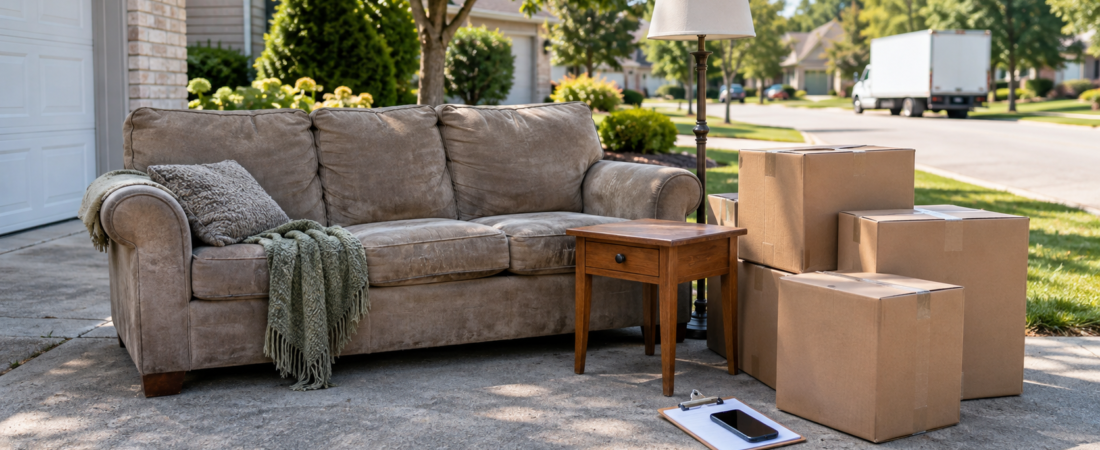
If you are wondering how junk removal works in London Ontario, the process usually begins with a clear description of what needs to go. You provide the item types, approximate quantity, pickup location, access conditions, photographs when possible, and preferred timing. A responding provider can then review the job, ask questions, discuss an estimate or quotation, and confirm whether the items and schedule fit its service. Before work begins, you should agree on the scope, price, loading responsibilities, and service terms.
The exact process varies by provider and project. A couch already beside a driveway is different from a basement cleanout involving stairs, or a commercial job with building-access rules. Photographs can help communicate the scope, but they may not capture every item, weight issue, carrying distance, or restricted material. Clear information at the beginning makes it easier to compare the available option and avoid confusion on pickup day.
You can request a free, no-obligation junk-removal quote by submitting your project details online. London Junk Removal Quotes is an independent quote-request website. We do not directly perform removal or send our own crew. Pricing, accepted items, availability, qualifications, and service terms are determined by the responding provider.
The junk-removal process in seven steps
| Step | What normally happens | What you should do |
|---|---|---|
| 1 | The project scope is identified | List everything that may need to go and separate items you are keeping |
| 2 | A quote request is submitted | Include quantities, photographs, location, access, and preferred timing |
| 3 | A provider reviews the request | Answer follow-up questions and disclose heavy, damaged, or unusual items |
| 4 | Pricing and terms are discussed | Compare the complete scope, not just one headline number |
| 5 | The appointment is confirmed | Verify the date, arrival expectations, property access, and payment method |
| 6 | The provider reviews and removes the approved items | Confirm the final scope before loading begins and keep wanted items separate |
| 7 | The job is closed out | Check the agreed area, request a receipt, and keep any written terms |
This is a general guide rather than a promise that every provider uses the same system. Some providers may offer a photo-based estimate, some may require an on-site review, and others may use both. A small exterior pickup may need little coordination, while a multi-room cleanout may require additional planning.
First, decide whether full-service junk removal fits the project
Full-service junk removal generally means that a provider arrives with a suitable vehicle and supplies the lifting and loading included in the approved scope. The customer identifies the unwanted items, and the provider removes the items it has agreed to accept. Transportation and disposal arrangements are normally part of the provider’s service, but the exact inclusions must be confirmed before booking.
This type of service may suit a project when:
- Unwanted items have already accumulated and can be removed during a scheduled visit
- Furniture, appliances, or boxes must be carried from inside a property
- Stairs, narrow halls, elevators, or a longer carrying distance are involved
- The customer does not have an appropriate vehicle or safe lifting help
- A landlord, property manager, or business has a deadline for clearing a space
- The amount of material is easier to explain as a defined pickup or cleanout
It may not be the only option. A self-loaded rental bin may fit ongoing renovation debris, and eligible London households may be able to book municipal collection for a limited number of accepted bulky items. The best route depends on the material, timing, labour, property space, and applicable rules.
Explore the junk-removal services for which quotes can be requested before choosing the most relevant form or service page.
Step 1: Make a complete removal inventory
Start by identifying the actual project rather than using a broad description such as “some junk” or “a garage full.” A provider needs enough detail to understand the likely volume, weight, labour, vehicle space, and disposal requirements.
Create four groups:
- Remove: items that should definitely leave the property
- Keep: belongings that must remain
- Donate or sell: usable belongings you want to handle separately
- Ask about: materials whose acceptance or preparation requirements are uncertain
For the removal group, record:
- The number of large items, such as couches, mattresses, tables, cabinets, or appliances
- The approximate number of boxes, bags, or smaller loose items
- Heavy or dense materials, including tile, soil, concrete, brick, or roofing material
- Damaged, wet, sharp, contaminated, or unusually awkward items
- Electronics, refrigerant-containing appliances, tires, batteries, paint, chemicals, fuel, propane cylinders, and other items that may have special requirements
- Whether disassembly may be needed to move anything through a doorway or stairwell
You do not need a perfect volume calculation. A complete list, useful photographs, and honest access details are more helpful than guessing at a truck fraction.
Take photographs that show both items and scale
A useful photo set can include:
- One wide image of each room, pile, or work area
- Closer images of large, heavy, damaged, or unusual items
- A view of the hallway, stairs, elevator, gate, or doorway the items must pass through
- A driveway or parking view when vehicle access may be limited
- A common object or visible room feature that helps show scale
Photographs are communication tools, not automatic price guarantees. Items hidden behind furniture, inside cabinets, under tarps, or beyond the edge of a photograph can change the actual scope.
Step 2: Submit a detailed quote request
A useful junk-removal quote request should answer six basic questions:
What needs to be removed?
Name the main item types and quantities. “One three-seat couch, one queen mattress, six sealed boxes, and one small wooden table” communicates much more than “furniture and junk.”
Where are the items located?
Explain whether they are outside, in a garage, on a main floor, upstairs, in a basement, in a storage locker, or spread across several areas.
What access is involved?
Mention stairs, elevators, narrow corners, low ceilings, long corridors, locked gates, parking restrictions, loading docks, limited driveway space, or a long carry to the vehicle.
Are any items unusually heavy or difficult?
Identify safes, pianos, exercise equipment, large appliances, stone, concrete, soil, oversized furniture, or anything that may require additional workers, equipment, or a different service.
When do you need the project completed?
Provide a preferred date and any real deadline, such as a move-out inspection, property closing, renovation start, or new-tenant occupancy. Availability is determined by the responding provider, so submit early when the date matters.
Is permission or coordination required?
For apartments, condominiums, offices, and rental properties, mention elevator reservations, loading-zone rules, concierge access, property-manager approval, restricted hours, or proof-of-insurance requirements that may apply.
You can submit these details through the London junk-removal quote form. If the project is outside London, review the current service areas and include the postal code.
Step 3: The responding provider reviews the project
After a request is received, an available provider may contact you to clarify the scope and discuss pricing or scheduling. Response time and availability depend on the provider, location, project size, and requested date.
The provider may ask for:
- Additional photographs or a short video
- Dimensions or quantities for large items
- Confirmation of floors, stairs, elevators, or carrying distance
- Details about parking and vehicle access
- Clarification about renovation debris, yard material, electronics, appliances, or potentially restricted products
- A site visit for a larger, uncertain, or multi-area cleanout
Answering these questions does not mean you must accept the service. The purpose is to reduce uncertainty so you can review a clearer proposal.
Remote estimate versus confirmed price
A price discussed from photographs, a phone conversation, or an online description may be an estimate based on the information available. The provider may need to see the items and access conditions before confirming the final scope and price.
Before scheduling, ask:
- Is this amount an estimate or a firm quote?
- What assumptions is it based on?
- Will the price be confirmed before loading starts?
- What could legitimately change it?
- What happens if the actual volume is larger or extra items are added?
A clear answer is more valuable than assuming that every number has the same meaning.
Step 4: Compare the whole quote before approving it
The lowest number is not automatically the lowest total cost. Two quotes can describe different amounts of work. One may include indoor carrying and disposal while another assumes everything is already outside. Compare the same scope line by line.
| Question to confirm | Why it matters |
|---|---|
| Which exact items and areas are included? | Prevents uncertainty about items omitted from the estimate |
| Is lifting from the current location included? | Indoor, basement, upstairs, or long-distance carrying may change labour |
| Is disassembly included when necessary? | Large furniture may not fit through the available route in one piece |
| Are transportation and disposal charges included? | Clarifies whether the quoted amount covers the full removal |
| Are stairs, elevators, or parking conditions accounted for? | Access can change time, staffing, and equipment needs |
| Which materials are not accepted? | Restricted items may need a separate legal disposal route |
| Is basic cleanup or sweeping included? | Some quotes cover removal only; others may include limited cleanup |
| What date or arrival window is offered? | Availability varies and should match the actual deadline |
| What happens if the load is different from the description? | Establishes how additions or scope changes will be priced |
| What payment methods and timing apply? | Avoids payment confusion after the work is complete |
| What cancellation or rescheduling terms apply? | Important when a move, tenant turnover, or contractor schedule may change |
| What provider credentials should be reviewed? | Customers should independently confirm insurance, qualifications, and any requirements relevant to the job |
Keep important details in writing when possible. For a larger property cleanout, a written scope is particularly useful because several rooms, decision-makers, or material types may be involved.
Step 5: Confirm the appointment and prepare access
Once you decide to proceed, confirm the appointment directly with the provider. Verify the service date, any arrival window, the property address, contact person, parking instructions, access procedure, expected payment method, and the items included in the approved scope.
Before the appointment:
- Move or clearly label anything that must remain
- Keep valuables, documents, medication, keys, and personal electronics away from removal areas
- Clear safe walking paths without attempting lifts you cannot manage safely
- Unlock gates, garages, storage rooms, or approved work areas
- Arrange elevator or loading-area access when the building requires it
- Move vehicles if the provider needs driveway access
- Secure children and pets away from the work route
- Empty personal contents from furniture, bags, boxes, and appliances
- Confirm required appliance disconnection and use a qualified trade where appropriate
- Set aside paint, chemicals, fuel, propane cylinders, asbestos-containing material, medical waste, and other potentially restricted products until an appropriate disposal route is confirmed
- Tell the provider promptly if the item list or access conditions have changed
Do not move heavy objects outside merely because you assume it is required. Confirm whether carrying from the current location is part of the proposed service. Preparing access should make the work area clearer, not create an injury risk.
Step 6: What usually happens on junk-removal day
The exact sequence depends on the provider and project, but removal day often includes the following stages.
Arrival and site access
The provider arrives at the agreed property and accesses the removal area according to the arrangements made. For apartments, condominiums, offices, or managed properties, the customer or authorized contact may need to provide entry and confirm building rules.
Walkthrough and scope confirmation
Before loading begins, identify the items to be removed and anything that must stay. If the provider has not yet seen the project in person, this is the time to compare the actual items with the description and photographs.
Price confirmation
Confirm the price or pricing method before authorizing the work. If there are more items, less material, a different access route, or an unreported special item, ask the provider to explain any proposed change before loading starts.
Loading the approved material
The provider loads the items included in the agreed scope. The number of workers, equipment, loading order, and removal method can vary. Keep out of active carrying paths unless the provider asks you to identify something.
Final check
Review the agreed removal areas before the provider leaves. Confirm that wanted belongings remain and that the items approved for removal have been addressed. If basic sweeping, disassembly debris, or another cleanup task was specifically included, check that part of the scope as well.
Payment and receipt
Pay according to the confirmed terms and request a receipt or written record. Retain the quote, invoice, and relevant messages for a larger or commercial project.
Step 7: Close out the job carefully
After the vehicle leaves, inspect the accessible work area and report any concern promptly through the provider’s stated contact method. Keep photographs, written scope, and payment records until the matter is complete.
If donation, recycling, special handling, or delivery to a particular facility was important to your decision, ask about it before booking. Practices vary by provider, and London Junk Removal Quotes does not make disposal or diversion claims on a provider’s behalf.
For future projects, note which information was most useful during the quote. A saved inventory format, a consistent set of photographs, and clear building-access instructions can make repeat cleanouts easier to explain.
How the process changes by project type
The seven basic steps remain similar, but the details that matter most change with the job.
| Project type | Important information to provide | Related service page |
|---|---|---|
| Couch, mattress, table, or other furniture | Quantity, dimensions, floor, doorway width, stairs, condition, and whether disassembly may be required | Furniture removal quotes |
| Refrigerator, freezer, washer, dryer, or stove | Appliance type, current location, stairs, connections, refrigerant, and whether qualified disconnection is complete | Appliance removal quotes |
| Garage cleanout | Approximate occupied area, dense materials, tools, automotive products, driveway access, and items that must remain | Garage cleanout quotes |
| Basement cleanout | Stair count and width, ceiling height, corners, moisture or contamination, large furniture, and carrying distance | Basement cleanout quotes |
| Landlord or rental-property cleanout | Legal authority to remove the items, unit access, elevator booking, turnover deadline, multiple rooms, and abandoned special materials | Rental-property cleanout quotes |
| Office, retail, or commercial removal | Site contact, loading dock, service elevator, restricted hours, security rules, equipment, records, and proof-of-insurance requirements | Commercial junk-removal quotes |
| Yard-waste project | Branch diameter, soil or sod, bags versus loose material, gate width, distance from the street, and mixed outdoor junk | Yard-waste removal quotes |
| Renovation debris | Material type, approximate volume, density, sharp edges, dust, nails, demolition status, and whether hazardous material may be present | Junk-removal services |
Single-item furniture pickup
A clear photograph, approximate dimensions, floor, door route, and parking details may be enough for a provider to assess a straightforward furniture request. Sofa beds, sectionals, glass components, unusually heavy pieces, and narrow stairwells should be identified in advance.
Appliance removal
Appliance work can involve weight, stairs, water lines, electrical connections, gas connections, or refrigerant. Never assume that disconnection is included. Ask what must be completed before arrival and arrange a qualified professional where required.
Basement and garage cleanouts
These projects often look smaller in photographs than they are because items are stacked, hidden, or distributed across shelves. Include several wide images and identify dense material, restricted products, narrow stairs, and anything blocking the exit path.
Rental and estate properties
The person authorizing removal should have the right to make decisions about the belongings. Separate documents, photographs, valuables, sentimental items, and anything whose ownership is unclear before the appointment. The removal provider is not responsible for deciding what should be kept.
Commercial properties
Business jobs may require coordination with a building manager, after-hours access, a loading dock, an elevator booking, security approval, or documentation. Records, electronics, inventory, and specialized equipment may also require separate handling.
What affects the timing of the process?
There is no universal scheduling promise. The time between request and completion can depend on:
- Provider availability
- Pickup location and service area
- Project size and number of areas
- Whether the item list is complete
- Photograph quality and the need for an on-site review
- Number of workers or type of vehicle required
- Stairs, elevators, parking, gates, and carrying distance
- Building permissions or reserved service times
- Material type, weight, and disposal route
- Weather or safe-access conditions
- Customer decision time and appointment changes
A detailed request submitted before a hard deadline gives the provider more information to assess the schedule. Same-day or next-day service may be advertised by individual companies, but it should never be assumed or promised by an independent quote-request website.
London’s bulky-item service may fit some residential pickups
Private junk removal is not the only route for every item. The City of London currently allows eligible curbside residential households to request collection for up to four large furniture or bulky items on a scheduled garbage-collection day. The City states that there is no booking fee, but the request must follow its booking and set-out requirements. Businesses are not eligible for that bulky-item booking service.
The City lists couches, mattresses, and large wooden bookshelves as examples. It also states that appliances, electronics, renovation materials, vehicle parts, batteries, tires, and mostly metal items are not accepted through this bulky-item curbside program. Requirements can change, so review the current City of London curbside garbage and bulky-item instructions before setting anything out.
Private junk removal may be worth considering when the item is not eligible for City bulky pickup, material must be carried from inside, there are more items than the municipal limit, a business or managed property is involved, or the City schedule does not fit the project. The provider must still confirm that it accepts the material.
Local drop-off and special-product options
London’s EnviroDepots accept certain waste, yard material, recyclables, electronics, scrap metal, batteries, tires, propane tanks, and other listed items. The City notes that EnviroDepots do not accept furniture or mattresses. Accepted items, limits, locations, hours, and fees should be checked before travelling.
For paint, gasoline, solvents, pesticides, pool chemicals, and other corrosive, flammable, poisonous, or reactive household products, review the City’s Household Hazardous and Special Products guidance. Do not conceal or mix these products into ordinary junk. Tell the responding provider what is present and use an appropriate disposal route.
Seven mistakes that can complicate a junk-removal appointment
1. Describing the project too vaguely
“A few things” can mean three bags or a room of mixed furniture. Give quantities, photographs, and access information.
2. Leaving heavy or restricted materials out of the request
Dense debris, chemicals, fuel, propane, batteries, liquids, contaminated material, and unusually heavy items can require different handling. Disclose them before scheduling.
3. Assuming a remote estimate can never change
Ask whether the amount is an estimate or confirmed quote and what assumptions it uses. A photograph cannot show every condition.
4. Comparing prices with different scopes
Confirm indoor carrying, disassembly, labour, transportation, disposal, taxes, special charges, and cleanup rather than comparing headline numbers alone.
5. Mixing wanted and unwanted belongings
Separate or label items before the walkthrough. Do not rely on a provider to know which similar boxes, bags, or furniture pieces should stay.
6. Forgetting property-access rules
Elevator bookings, parking restrictions, loading zones, locked gates, condominium rules, and business security procedures can delay or prevent access.
7. Adding items without discussing the change
The approved quote is based on a described scope. If more material is added, ask the provider to explain any price or capacity change before loading it.
Final checklist before you authorize the work
Confirm that you know:
- Which items and rooms are included
- Which items are excluded or require another disposal route
- Whether lifting from the current location is included
- Whether stairs, elevators, parking, and carrying distance were considered
- Whether the amount is an estimate or confirmed price
- What may change the price
- Whether transportation and disposal are included
- Whether taxes or other stated charges apply
- Whether disassembly or basic cleanup is included
- The appointment date and arrival expectations
- The cancellation or rescheduling terms
- The accepted payment methods
- Which provider is performing the work
- Which credentials or insurance details you want to verify
If an important point is unclear, ask before work begins.
Frequently asked questions
How does junk removal work in London, Ontario?
You describe the unwanted items, pickup location, access, and preferred timing. A responding provider may ask questions, review photographs, discuss an estimate or quotation, and offer an appointment. Before loading begins, confirm the items, price, labour, disposal, and other service terms directly with that provider.
What information should I include in a junk-removal quote request?
Include the item types and quantities, photographs, floor or outdoor location, stairs or elevator details, doorway or parking restrictions, heavy or special materials, postal code, and preferred completion date. A complete description helps the provider understand the project.
Can I receive a quote from photographs?
Some providers may offer an estimate or quote after reviewing clear photographs and project details. Others may require an on-site assessment. Ask whether the amount is firm, what it includes, and whether it will be confirmed before loading.
Do I need to move everything outside?
Not necessarily. Some full-service quotes may include carrying approved items from inside the property. Confirm the current item location and whether indoor lifting, stairs, or disassembly are included. Do not attempt unsafe lifting simply to prepare.
Do I have to be home during pickup?
That depends on the provider, property, payment arrangements, and whether an authorized person must identify the items or approve the final scope. Confirm attendance, access, and authorization requirements before the appointment.
Can I add more items on removal day?
Possibly, but additional items can change vehicle capacity, labour, disposal needs, and price. Show the provider everything before loading begins and approve any revised scope or price first.
Does a junk-removal quote always include labour and disposal?
Inclusions vary. Ask whether the quoted scope includes lifting, loading, disassembly, transportation, disposal, taxes, special-item handling, and any agreed cleanup. Compare written inclusions rather than assuming.
How quickly can junk removal be scheduled in London?
Scheduling depends on provider availability, location, job size, item type, access, and the requested date. Submit the request early when you have a move, closing, tenant turnover, or other fixed deadline. London Junk Removal Quotes does not guarantee a response or pickup time.
Can ordinary junk removal include paint, fuel, chemicals, or propane cylinders?
Do not assume it can. These materials may be restricted or require a special disposal route. Identify them before booking, ask the provider what it accepts, and check the City of London’s current hazardous and special-products guidance.
Is City bulky-item pickup the same as private junk removal?
No. The City program has its own eligibility, booking, item-limit, accepted-material, schedule, and curb-set-out rules. Private providers set their own services and may offer indoor loading or handle project types outside the municipal program, subject to provider acceptance.
Does London Junk Removal Quotes send a removal crew?
No. London Junk Removal Quotes is an independent quote-request and lead-generation website. It may connect a customer’s inquiry with an independent provider. The responding provider is responsible for its quotation, scheduling, qualifications, insurance, accepted materials, disposal practices, customer service, and completion of the work.
Request a junk-removal quote in London, Ontario
The most useful first step is a clear project description. List what needs to go, include photographs, explain stairs or other access conditions, provide your postal code, and state your preferred timing. An available provider can then review the request and discuss whether the project fits its service.
Request My Free Junk-Removal Quote
London Junk Removal Quotes is an independent quote-request website and does not directly perform junk removal. Submitting a request does not require you to accept a quote. Provider availability is not guaranteed. Pricing, scheduling, qualifications, insurance, accepted items, disposal practices, and service terms must be confirmed directly with the responding provider.